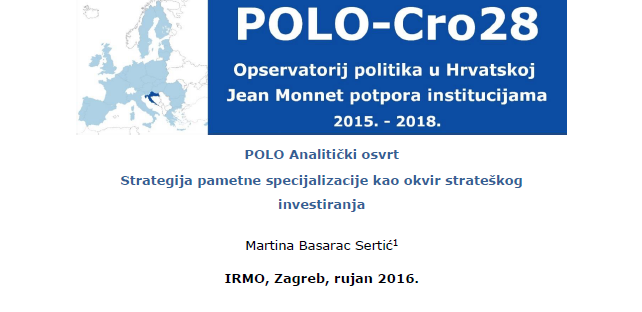
Commentary by young researches on Smart specialisation published

Strategy for smart specialisation as a fremework for strategic investment‘ is the fifth commentary within the project POLO-Cro28, written by Martina Basarac Sertić, research associate at the Croatian Academy of Sciences and Arts – CASA. This commentary analyses the goal, the purpose and the content of strategies for smart specialisation and provides a parallel overview of thematic priority areas in Croatia and selected new EU Member States (the Czech Republic, Hungary, Slovakia and Slovenia). Furthermore, the commentary explains the origin and sequences of establishing these strategies as well as their importance in the context of EU Cohesion policy. The main aim is to assist in better understanding of strategies for smart specialisation – a new concept of industrial policy in order to develop innovative economy and achieve economic growth and prosperity of the EU Member States. Having an insight into the backbone of these strategies it can be concluded that smart specialisation is an opportunity to shift from the low levels of balance and to increase the overall competitiveness in the EU as well as for the reduction of mutual differences among the Member States.

The full text si available on the following link (Croatia only) :

http://polocro28.irmo.hr/wp-content/uploads/2016/09/POLO-osvrt-Smart-specialisation.pdf

European Pillar of Social Rights – positions of BusinessEurope-a

The organization Business Europe which represents employers at the EU level on the 24th of August 2016 has published its contribution to debate about the European Pillar of Social Rights, launched in March of this year. Through the European Pillar of Social Rights the EU attempts to supplement the social acquis, in order to guide the Euro zone members, and other EU members on the voluntary bases, in the fields essential for well-functioning of the labour markets and welfare systems. The position of BusinessEurope towards this initiative is fairly reserved because the organisation fears that the EU could address the gaps in the EU social legislation according to ‛common high level standards’, which could have negative economic consequences. They underline that Europe’s social problems are not due to a deficit of social policy but to lack of competitiveness and that social problems could be overcome only through economic growth and increased employment. However, BusinessEurope welcomes the announced development of benchmarks within the European Pillar of Social Rights, since they could support implementation of reforms and linkages with the European Semester.

More information:

https://be-extranet-prod.s3.amazonaws.com/publications/2016-08-25_pillar_social_rights.pdf

http://eur-lex.europa.eu/legal-content/EN/TXT/?uri=CELEX:52016DC0127

IRMO representative on Jean Monnet Seminar in Malmö, Sweden

Dr Višnja Samardžija took part in the Jean Monnet Seminar “European Union ‘à la carte” which took part from 19-21 June in in Malmö, Sweden. The participants had the opportunity to discuss different aspects of differentiated integration within three panels – the Fiscal and Monetary Union, the Energy Union and the Common Security and Defence.

The IRMO study on the nonstandard work in Croatia published

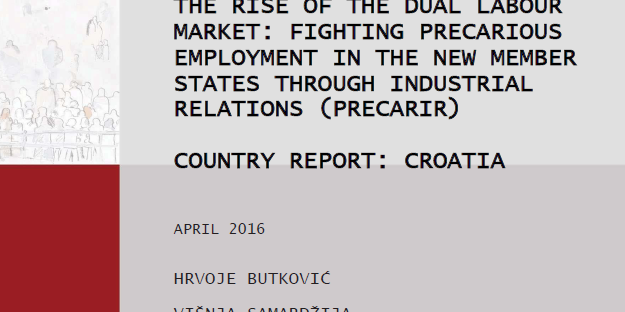
The team of IRMO researchers (Hrvoje Butković and Višnja Samardžija in cooperation with Ivana Skazlić and Ivana Čavar) has published a study about the nonstandard work in Croatia in the period since outbreak of the economic crisis. The study is focused on the activities of the trade unions and employers related to increase of the nonstandard work in the sectors of construction, metal industry, retail trade, public healthcare and agency work. The study, among other topics, addresses the issue of youth unemployment which in Croatia is one of the highest in the EU. The youth were identified as particularly vulnerable group because crisis further complicated their entrance to the labour market, while they are mostly employed on fixed-term contracts. The research was implemented within the project ‛PRECARIR – The rise of the dual labour market: fighting precarious employment in the new member states through industrial relations’ financed by the European Commission. IRMO implements this project as a partner from Croatia while it is coordinated by the Dublin City University (DCU). Together with nine other national studies it was published as a CELSI Research Report at the webpage of the CELSI institute from Bratislava.

More information:
The study is available in the electronic form.

Višnja Samardžija participated at the biennial ECSA-C conference The European Union and North America: an inevitable partnership?

Halifax, Canada
May 9-11, 2016

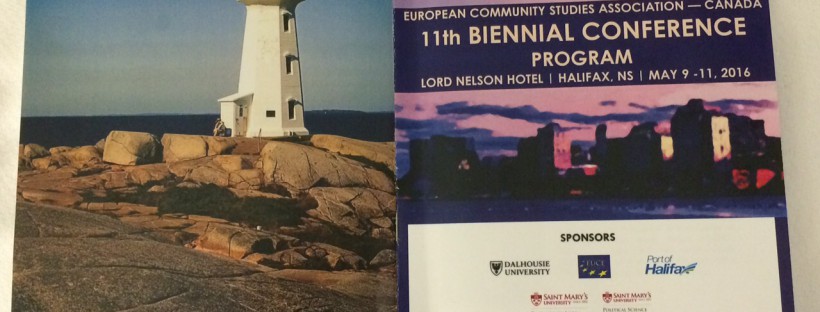
The Head of Department for European integration Visnja Samardzija participated at the conference The European Union and North America: an inevitable partnership?, taking place in Halifax, May 9-11 2016. The European Community Studies Association – Canada (ECSA-C) organizes international research conference that is held every two years and co-funded by the Erasmus+ programme of the European Union. ECSA-C’s mission is to help promote the study of the European Union and its Member States in Canada. Visnja Samardzija presented a research paper Comparing the Economic Governance in the New EU Member States – is the European Semester a Success or Failure? at the fourth session entitled Economic Policy and Transatlantic Relations. The paper is prepared in co-authorship with Ivana Skazlic from IRMO and is resulting from the project “Policy Observatory in Croatia (POLO-Cro28)” funded by the European Commission through the ERASMUS + programme, Jean Monnet Support to Institutions.

The National Reform Program and the Convergence Program for 2016-2019 adopted

The Croatian Government has adopted the 2016-2019 National Reform Program and Convergence Program on 28th April 2016, drafted within the process of the European Semester. The National Reform Program identifies 4 main goals and reform areas for 2016 and 2017, including: macroeconomic stability and fiscal sustainability; improved conditions for business and better investment climate; increased efficiency and transparency of the public sector as well as better alignment between education system and the needs of the labor market. The Government intends to achieve these goals by implementing a total of 61 reform measures. The Convergence Program indicates further continuation of fiscal consolidation in the following medium-term period. Based on the assessment of these documents, the European Commission will decide whether to initiate Excessive Imbalance Procedure for Croatia but also it will use them for preparation of the new set of Country Specific Recommendations for Croatia.

More information:

http://ec.europa.eu/europe2020/pdf/csr2016/nrp2016_croatia_en.pdf

http://www.mfin.hr/adminmax/docs/Program%20konvergencije%20RH%20za%20razdoblje%202016.%20-%202019.pdf

A meeting of the IRMO project team for the implementation of ‘POLO-Cro28 – Policy Observatory in Croatia’ was held

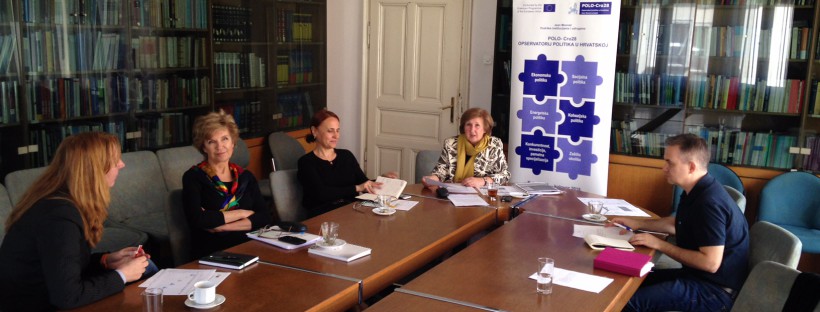
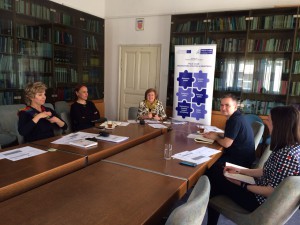
A meeting of the ‘POLO-Cro28 – Policy Observatory in Croatia’ IRMO project team was held on Thursday 15th April 2016 in the IRMO library. The project was awarded to the IRMO under the Erasmus+ program. The IRMO research team has reviewed and discussed the first eight months of the project implementation and it has also agreed on the activities for the following period of project implementation. In accordance with the planned project activities of the project ‘POLO-Cro28 – Policy Observatory in Croatia’, the following activities were implemented so far: Kick-off meeting was held, 4 analytical commentaries by young IRMO researches have been published, one round table discussion has been organized at the European Commission Representation in Zagreb, the project’s website has been established and soon the first policy paper by IRMO researches will be published.

IMG_0928

The EC Published a Report on Macroeconomic Imbalances for Croatia

On 26th February 2016 the European Commission has published 2016 Country Report for Croatia including an In-Depth Review on the prevention and correction of macroeconomic imbalances. This Report is a result of the Alert Mechanism Report (AMR) of November 2016, which kicks-off the annual Macroeconomic Imbalance Procedure (IMP). The AMR is an early-warning mechanism for identification of the member states with a potential risk of harmful macroeconomic imbalances. The fifth AMR of November 2016 identified a total of 18 member states, including Croatia, for which a closer analysis (in-depth review) is deemed necessary.
The 2016 In-Depth Review (IDR) for Croatia provides a detailed analysis of the key economic issues and challenges facing the Croatian economy. Moreover, the IDR contains summary assessment of Croatia’s implementation of the 2015 country specific recommendations (CSRs). According to the IDR, Croatia has made some progress in addressing only 1 CSR, while it has made a limited progress in addressing other 5 CSRs. The IDR also provides progress assessment regarding the achievements of national Europe 2020 targets.

More information available on: http://ec.europa.eu/europe2020/pdf/csr2016/cr2016_croatia_en.pdf

The European Commission forecasts for 2016 continued growth in Croatia

On 4th February 2016, the European Commission has announced the Winter 2016 Economic Forecast with updated growth projections for the European Union and its member states. According to the Commission’s winter forecast, growth in the euro area is projected to increase to 1.7% in 2016 (from 1.6% last year), and to rise to 1.9% in 2017. In 2016 EU economic growth is forecast to remain stable at 1.9% and is expected to grow to 2.0% next year. According to the Commission’s projections, the economic growth in Croatia is expected to grow by 1.8% in 2015, and is projected to increase to 2,1% in 2016 and 2017. The basis for these projections lies within further acceleration of the domestic demand, as the main driver of growth. This, coupled with improving labour market conditions which will contribute to increasing household spending as well as speeding up of the investments due to improved absorption of EU funds, contributed to overall growth expectations by 2.1% in next two years.
More information: http://ec.europa.eu/economy_finance/eu/forecasts/2016_winter_forecast_en.htm

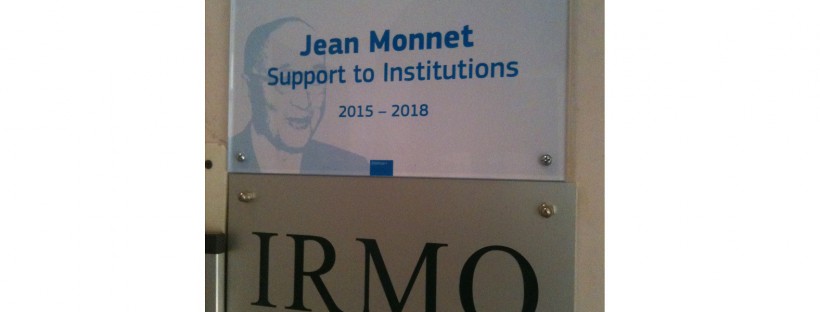
Jean Monnet Plaque awarded to IRMO

By 2018, the plaque for Jean Monnet Support to Institution awarded to IRMO by the Education, Audiovisual and Culture Executive Agency (EACEA) will be placed at the entrance of Institute. The Agency explains that purpose of this plaque is twofold. It serves primarily as a label signifying quality in European integration studies and represents the achievements of IRMO’s Support to Institution in this field. At the same time it also provides visibility for the Jean Monnet Action, presenting it as the focal point within and outside IRMO for the promotion of European issues.